

![18 Essential Employee Pulse Survey Questions [2026 List]](/_next/image/?url=https%3A%2F%2Fstatic.surveysparrow.com%2Fsite%2Fstrapi-content%2Fuploads%2F2026%2F01%2Flarge_38_b63c708373.png&w=3840&q=100 "18 Essential Employee Pulse Survey Questions [2026 List]")


Employee expectations are changing faster than ever.
Today, an estimated 74–80% of employees say they want to share feedback more often than once a year. However, only 40–50% of organizations still rely on annual employee surveys, according to Gallup’s 2025 workforce research. This growing feedback gap leads directly to disengagement, frustration, lower trust, and preventable employee attrition.
That’s where employee pulse survey questions come in.
What are employee pulse survey questions?
Employee pulse survey questions are short, frequent employee feedback questions used to measure real-time sentiment, engagement, and workplace experience.
Unlike annual surveys, employee pulse surveys allow organizations to identify issues early, improve engagement continuously, and make faster, data-driven decisions. Research consistently shows that organizations with high employee engagement outperform competitors in productivity, innovation, and retention.
If you want honest, actionable feedback that leads to measurable change, these 18 high-impact employee pulse survey questions will help you collect insights and respond effectively in 2026.
Why use employee pulse survey questions in 2026?
Employees no longer want to wait a year to be heard and leaders can no longer afford to wait a year to listen.
These 18 high-impact employee pulse survey questions help organizations:
- Gather honest feedback without survey fatigue
- Understand what’s working (and what isn’t)
- Take timely, data-backed action
To make pulse surveys truly effective in 2026, organizations need tools that support speed, clarity, and follow-through—not just data collection.
This is where platforms like SurveySparrow come into play.
Collecting feedback is only the first step.
Many organizations struggle to keep pulse surveys short, engaging, and consistent—especially as employee expectations rise.
Tools like SurveySparrow help teams run lightweight pulse surveys that feel conversational rather than transactional, making it easier to listen to employees more frequently without adding survey fatigue.
1. Do you feel recognized for your contributions?
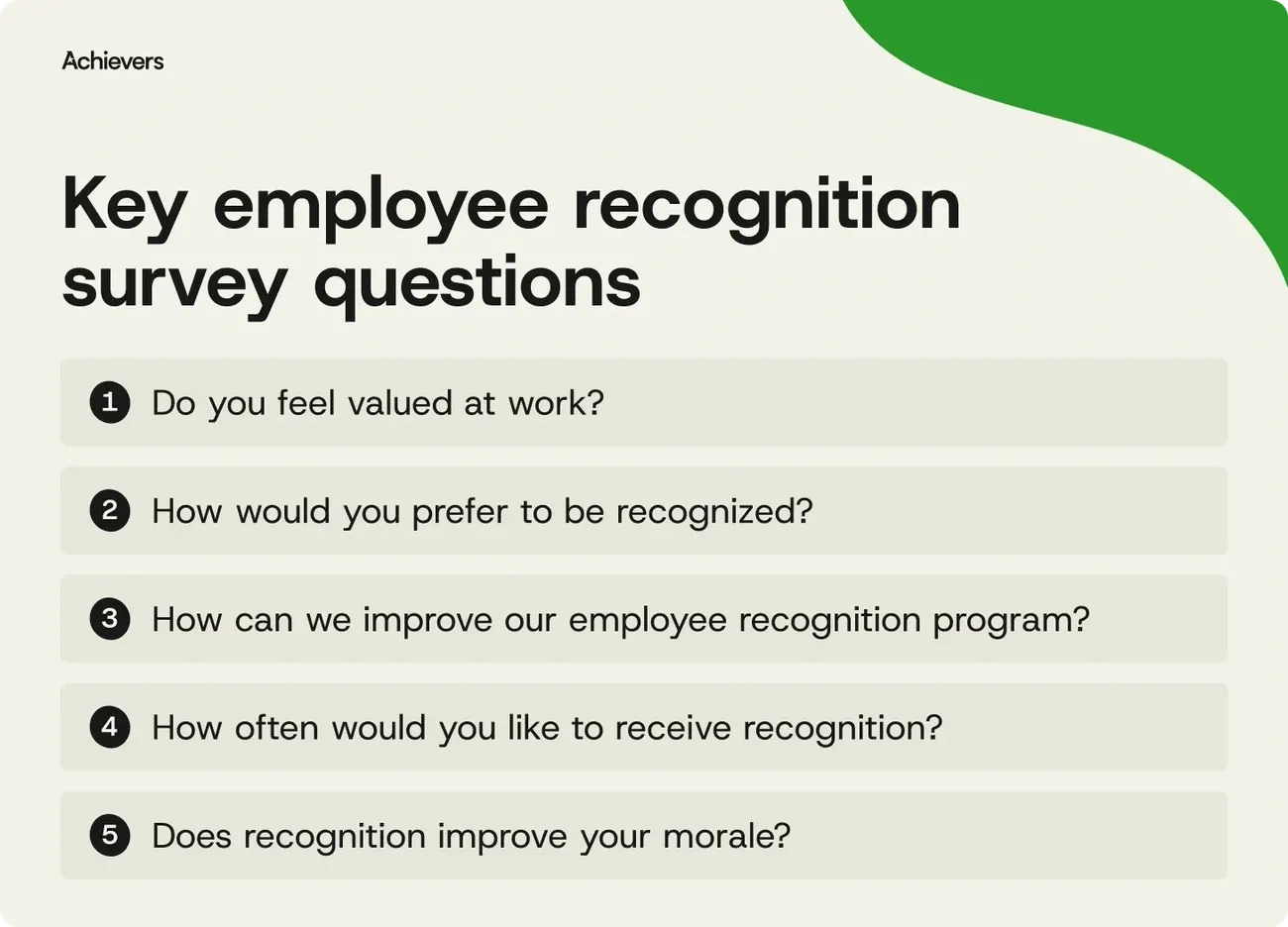
Image Source: Achievers
Why this employee pulse survey question matters
Employee recognition is the #1 driver of motivation, engagement, and retention.. Your employees are twice as likely to quit within a year if they don't feel appreciated. On top of that, 79% of people cite "lack of appreciation" as their reason to leave jobs. Organizations that recognize employees consistently see higher retention, stronger engagement, and better business outcomes.
Recognition boosts performance beyond just retention. Employees become 2.7x more likely to stay highly engaged when they expect recognition. Companies that have formal recognition programs see 31% less voluntary turnover and are 12x more likely to achieve strong business outcomes.
How to interpret responses
Low scores signal a critical recognition gap that often exists at the manager level.Compare results across teams to identify managers who consistently recognize contributions—and those who may need coaching. Only one in three U.S. employees strongly agree they received recognition in the past week, making this a high-impact improvement area.
Watch for response patterns. Do certain departments or demographic groups feel less recognized? Recognition from immediate managers holds the most weight (28%), with high-level leaders following at (24%).
Follow-up actions if recognition is low
Use these best practices to improve recognition quickly:
- Coach managers to recognize contributions at least once every 7 days
- Implement both formal and informal recognition programs
- Personalize recognition—specific, authentic praise is most effective
- Create public recognition opportunities such as awards or town halls
- Enable peer-to-peer recognition systems
- Tie recognition directly to company values and measurable impact
Note: Recognition does not have to be monetary. Public acknowledgment, private praise from leaders, and meaningful feedback are consistently ranked as the most valued forms of recognition. Frequent, specific, and values-aligned recognition has the strongest impact on engagement and retention.
2. Do you have the tools and resources to do your job well?
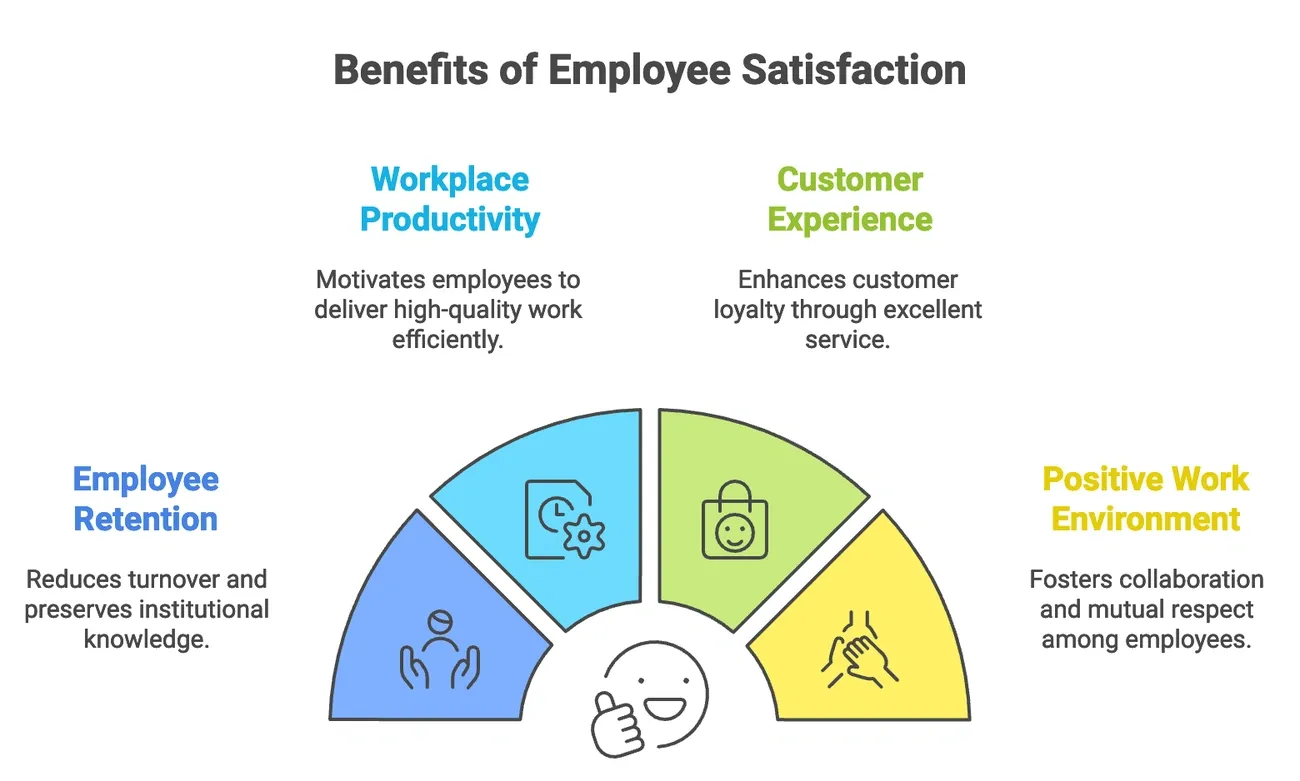
Image Source: Vantage Circle
A recent Gallup poll found that only 40% of employees believe they have the materials and equipment needed to do their job well. This basic survey question reveals a crucial workplace gap that affects productivity, employee involvement, and your bottom line.
Why this employee pulse survey question matters
The right tools and resources are vital to your organization's success. Time remains your business's most precious resource. The proper tools boost productivity - an invisible asset that lifts employee contributions, satisfaction, and morale.
Studies show employees with access to the right equipment deliver better customer service, produce more, and maintain safer work practices. Companies that provide digital productivity tools see their staff twice as likely to report better work-life balance.
Poor resources silently drain workplace happiness. Nearly all workers - 96% - dislike some of their tools. This creates stress and burnout, which often leads them to quit.
How to interpret responses
Low scores point to urgent resource gaps across teams. Look for patterns - do certain departments keep reporting shortages? Note that "materials and equipment" covers both physical items (software, office supplies) and non-physical resources (knowledge sharing, permissions).
High scores show your organization gives staff what they need to perform at their best.
Follow-up action ideas
If resource scores are low:
- Run focused reviews to spot gaps in tools, training, or information access
- Schedule regular discussions about resource needs—your team's requirements might surprise you
- Rank requests by their effect and feasibility
- Get digital tools that make work efficient—70% of employees say these reduce stress
- Keep in mind that too many resources cause quality issues and slow down work
Your proactive approach to resource needs will help employees do their best work without unnecessary barriers.
3. How likely are you to recommend this company to a friend?

The Net Promoter Score (eNPS) question stands out as your best pulse survey metric to measure overall sentiment and loyalty. This simple yet powerful question shows if your employees truly believe in your company's culture and future.
Why this employee pulse survey question matters
The eNPS question helps us learn about employee engagement through a simple question: "How likely are you to recommend this company as a workplace to friends and family?" Employees rate their response on a scale of 0-10. This approach gives better results than standard satisfaction surveys.
Your organization's brand ambassadors emerge naturally when employees recommend their workplace to others. This enhances your reputation and recruitment efforts. The numbers tell an interesting story - referred candidates stick around 45% longer than non-referred hires. This shows how positive employee feelings directly boost retention and hiring quality.
Organizations with good eNPS scores (10-30) show higher employee engagement levels and better business results. A quarterly check of this metric gives you a clear picture of your organization's health.
How to interpret responses
Your eNPS calculation is straightforward. Take the percentage of promoters (9-10 scores), subtract the percentage of detractors (0-6 scores), and you'll get a number between -100 and 100. People who score 7-8 are "passives" and don't count in the math.
An eNPS above 40 shows excellence, while negative scores point to systemic workplace problems that need quick fixes. Most industries see scores between 0 and 30.
Follow-up action ideas
Here's what you can do to boost low eNPS scores:
- Ask open questions like "What's the reason for giving that score?" to understand the context better
- Show results openly to leadership teams and departments to spot patterns
- Build focused action plans based on feedback themes and let employees know about these plans
- Run quarterly pulse surveys to track progress without overwhelming employees
Real value comes when you act on feedback. Employees become your strongest supporters when they see their input create real change.
Collecting feedback is easy. Acting on it is where most teams struggle.
Tools like SurveySparrow help teams go beyond scores by capturing context, tracking trends over time, and sharing insights automatically—so employee feedback leads to visible change.
14-day free trial • Cancel Anytime • No Credit Card Required • No Strings Attached
4. Do you feel your manager supports your career growth?
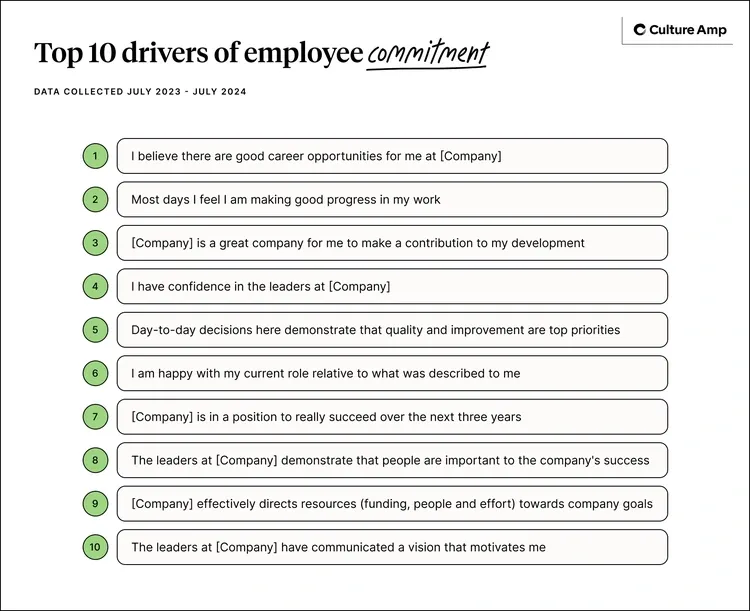
Image Source: Culture Amp
Career growth opportunities are the top driver of employee workplace well-being. This is a big deal as it means that job security comes second. Research shows 63% of employees who quit their jobs in 2021 pointed to limited advancement opportunities as their main reason for leaving.
Why this employee pulse survey question matters
Direct managers shape whether employees thrive or disconnect from their work. The data tells an interesting story. Employees who talk about their careers with managers more than once a month show much higher engagement (82%). This number drops to 53% for those who have these conversations yearly or less frequently.
This question reveals how well your organization supports career development. Nearly a quarter of employees list lack of career opportunities as their top reason to leave - even in companies with highly-rated work cultures.
How to interpret responses
Low scores suggest managers might not prioritize career development talks or provide enough growth opportunities. Look at department differences to spot managers who excel at supporting career growth.
Keep an eye on demographic trends. Some teams might consistently report better support than others. This could mean certain managers need extra coaching to lead career conversations effectively.
Follow-up action ideas
When scores point to room for improvement:
- Train managers to lead regular, meaningful career conversations
- Create customized development plans that match individual goals with organizational needs
- Build succession plans that show investment in high-potential employees
- Set aside time for learning and professional development
- Schedule regular check-ins between performance reviews to track growth progress
5. Do you feel connected to your team?
Teams thrive on connection. Research reveals that team members are more than twice as likely to be fully engaged when they feel part of the group. This directly impacts your organization's bottom line.
Why this employee pulse survey question matters
Employees who feel connected are more than 2× more engaged and significantly more productive. Strong team bonds improve trust, innovation, and retention.
95% of employees with high psychological safety say they belong, compared to just 69% of those with low psychological safety. Teams who collaborate regularly are 50% more efficient at their tasks. These teams also show better innovation and feel more satisfied with their jobs.
How to interpret responses
Low scores usually point to communication barriers or trust issues. Looking at how responses differ between departments can reveal leadership strengths or highlight areas where managers need to encourage better connections.
Watch out for remote or hybrid workers - their responses might show they're feeling isolated.
Follow-up action ideas
Here's how to build stronger team connections:
- Create regular chances for meaningful interaction beyond daily tasks
- Set up team activities that build psychological safety
- Start mentorship programs that connect new employees with experienced team members
- Create physical or virtual spaces that make shared work easier
- Help managers spot connection barriers, since 94% of employees say belonging is essential
Connected teams aren't just happier - they give your organization a competitive edge.
6. Do you feel safe sharing honest feedback here?
This question measures psychological safety and freedom to speak up without fear.
Why this employee pulse survey question matters
Psychological safety—knowing you won't face punishment for speaking up—directly affects innovation and performance. Teams with high psychological safety are more likely to participate in interpersonal risk-taking that accelerates organizational innovation. Low safety levels allow ineffective initiatives to continue unchecked. This leads to undetected failures and disengaged talent.
Different groups experience this challenge uniquely. Almost half of female business leaders find it hard to speak up in virtual meetings. Measuring psychological safety helps identify which voices might not be heard.
How to interpret responses
Low scores usually indicate that employees fear backlash from honest communication. Team variations often reflect how different leaders handle feedback. Responses from underrepresented groups deserve extra attention as they might face additional barriers to psychological safety.
Follow-up action ideas
Your organization can strengthen psychological safety by:
- Teaching leaders to show vulnerability through openly admitting mistakes
- Building structured opportunities for feedback without defensiveness
- Acknowledging team members who share honest thoughts
- Using powerful, open-ended questions and active listening
- Running regular pulse surveys through SurveySparrow to track psychological safety trends
Where many pulse surveys fall short
Even when organizations ask the right questions, feedback often stalls at dashboards. Employees stop responding when they don’t see action.
Platforms like SurveySparrow help close this gap by combining pulse surveys with sentiment analysis and automated insight sharing—so feedback reaches the right people while it’s still relevant.
7. Do you understand how your work contributes to company goals?
A recent study shows that 70% of workers don't have clear goals at work. This insight reveals if your team members understand how their everyday work contributes to the company's success.
Why this employee pulse survey question matters
People work better when they have specific goals instead of unclear expectations. Clear objectives help employees make smart choices about their time and resources.
Companies that set clear goals see 30% higher employee engagement. Teams that match employee goals with company objectives boost their results by 22%. Clear goals also lead to 25% better teamwork and creative solutions.
How to interpret responses
Low scores point to a disconnect between employees and the company's mission. Different scores across departments often show how well leaders communicate with their teams.
The gap between new and experienced staff members' understanding highlights the quality of your onboarding process.
Follow-up action ideas
Here's how to help employees understand their goals better:
- Design visual maps that show how each person's work affects company goals
- Set up regular meetings to share progress on key metrics
- Help managers explain team goals using step-by-step frameworks
- Let employees help set their goals to build commitment
- Schedule weekly check-ins to connect daily tasks with bigger objectives
Employees who see their role in the company's success make better decisions, work well with others, and stay motivated.
8. Do you feel your workload is manageable?
Recent research shows a troubling trend: 80% of global knowledge workers say they feel overworked and are close to burnout. This pulse survey question helps identify if your team members are reaching their limits before their work quality and participation suffer.
Why this employee pulse survey question matters
Your organization's health and performance depend on workload management. About 41% of employees point to excessive workload as the main reason for workplace stress. This creates a vicious cycle where stress reduces engagement. The numbers tell the story - 82% of employees become less engaged when they're stressed.
This goes far beyond just getting work done. People who work more than 40 hours each week become so unproductive that experts call it "useless". The financial toll is huge - U.S. corporations lose approximately $1.80 trillion due to burnout.
How to interpret responses
Poor scores typically show widespread workload problems. You should look for team patterns - does one department always report too much work? Watch for red flags like team members working late, sending emails outside work hours, or taking many sick days.
Follow-up action ideas
You can improve workload management by:
- Starting regular one-on-one meetings about capacity and stress
- Building clear task priority systems
- Teaching managers to spot burnout signs early
- Setting up structured breaks and boundaries for better well-being
- Using tools to spot workload issues before they grow
Regular pulse surveys with this question help you distribute work better and reduce burnout while making your team more productive.
9. Do you feel valued by leadership?
Half of all employees plan to seek new jobs within a year if they don't feel valued at work. This survey question reveals how well leadership's actions make employees feel appreciated.
Why this employee pulse survey question matters
Leadership's ability to make employees feel valued creates lasting effects throughout organizations. Valued employees show improved physical and mental health, along with higher engagement levels (93% compared to 33% for undervalued employees). Their motivation levels also surge higher (88%) than their undervalued counterparts (38%).
Valued employees help build stronger workplace cultures. Employee recognition stands as organizations' top strategic priority in 2024, showing its crucial business value.
How to interpret responses
Team variations often point to different leadership effectiveness levels. Key factors that make employees feel undervalued include restricted decision-making opportunities (24% vs 84%) and poor monetary compensation (18% vs 69%).
More than one in five American workers don't feel valued by their employers, making this challenge widespread.
Follow-up action ideas
Leadership valuation scores can improve through these steps:
- Managers should learn to express specific, meaningful appreciation—avoiding "empty gestures" that 40% of employees report receiving
- Leaders need regular chances to acknowledge contributions publicly
- Both formal and individual-specific recognition approaches should be implemented
- Recognition should link directly to business results by clearly describing employee contributions and their importance
10. Do you have opportunities to learn and grow?
Companies that invest in their employees' growth show 11% greater profitability and their staff members are twice as likely to stay. This survey question shows if your workplace helps people grow and learn - something we all need.
Why this employee pulse survey question matters
Career development directly keeps people around - almost 9 in 10 millennials say professional growth is crucial for job satisfaction. Beyond just keeping talent, growth opportunities help achieve both career goals and social wellbeing.
A culture of learning gives businesses significant advantages. Companies that prioritize development perform better at organic growth. Employees dealing with COVID-19 anxiety find career growth opportunities even more valuable, especially when job security feels shaky.
How to interpret responses
Poor scores usually point to weak development programs. Patterns might emerge between departments or groups - 70% of workers believe their company could do better with learning and development.
Age differences matter here. Staff members between 18-34 years old (44%) might leave their jobs if they don't see enough chances to grow.
Follow-up action ideas
Your learning culture can improve by:
- Making growth plans that match employee goals with company needs
- Offering flexible learning options that fit different styles and make jobs more satisfying
- Teaching managers to support growth, since 53% of workers say their managers can't help them advance
- Checking progress often because development plans need constant updates
11. Do you feel the company supports your well-being?
A recent survey shows only one in four U.S. employees strongly agree their organization cares about their overall wellbeing. This pulse survey question reveals if your company's wellness efforts strike a chord with your workforce.
Why this employee pulse survey question matters
Employee wellbeing directly affects business outcomes. Companies that support wellbeing see lower turnover rates. Their employees are 32% less likely to look for another job. Organizations with complete wellness programs report less absenteeism, better productivity, and an improved workplace culture.
The numbers tell a compelling story—wellness initiatives deliver an average ROI of $5.30 for every $1 invested. Employees who receive wellbeing support are almost twice as likely to feel happy at work.
How to interpret responses
Score disparities often point to a gap between leadership's perception and employee reality. While 87% of senior managers believe their company makes wellbeing a priority, only 74% of team members share this view. You should look at differences between departments and tenure levels. Employees with 3-10 years of service typically give the lowest scores on wellbeing questions.
Follow-up action ideas
Here's how to boost wellbeing support:
- Build programs that cover all five wellbeing pillars: career, social, physical, financial, and community
- Leadership must actively participate—employee engagement rises from 44% to 80% when leaders use wellness resources
- Set up peer support groups for specific needs like working parents
- Track program success beyond participation numbers, since all but one of these organizations measure wellness ROI
12. Do you feel included and respected at work?
A recent Georgetown University poll of 20,000 global employees revealed something unexpected - respect topped the list of desired leadership traits. It ranked higher than communication skills, work ethic, and empathy. This simple survey question shows if your workplace truly values belonging and dignity.
Why this employee pulse survey question matters
Your organization's performance depends on inclusion. Teams with high inclusion scores show remarkable results - members are 45% more likely to stay and 90% more ready to help their colleagues. When people feel they belong, they become more productive, generate better ideas, and make smarter decisions.
People thrive when they can be themselves at work without hiding who they are. But inclusion needs real action - your workforce won't buy into empty promises without solid policies to back them up.
How to interpret responses
Low scores usually point to deeper problems with transparency or harassment policies. Nearly 60% of workplace misconduct never gets reported. Look for patterns where specific groups consistently feel less included, since people's experiences can vary based on their role and identity.
Follow-up action ideas
To build a more inclusive workplace:
- Train leaders to model respectful behaviors consistently
- Create clear guidelines defining workplace respect
- Implement transparent communication channels
- Establish swift consequences for verified harassment
- Recognize employees who demonstrate inclusive actions
13. Do you receive timely communication from leadership?
Poor leadership communication affects employee engagement and costs large companies USD 64.20 million annually. This pulse survey question helps determine if your organization meets employee expectations for information flow.
Why this employee pulse survey question matters
Trust forms the foundation of successful workplace relationships, and good communication builds it. Leaders who communicate openly establish credibility. This helps employees feel secure and lines them up with company direction.
Research shows that 85% of employees feel motivated by regular company updates from management. A notable gap exists - 80% of leaders think their updates are clear and get people to participate, but only 50% of employees share this view.
How to interpret responses
Teams that score low might face delays in getting information or lack transparency. Different departments may show varying scores, which can point to leaders who excel at timing their communications. Teams grow anxious when leaders stay silent too long.
Follow-up action ideas
These steps can enhance communication timing:
- Schedule regular updates, even without new developments
- Help leaders communicate ahead of issues rather than react to them
- Track communication success through specific metrics
- Set up clear two-way communication channels - employees who can give feedback about organizational changes are 7.4 times more likely to trust leadership
14. Do you feel empowered to make decisions in your role?
Teams that feel equipped to make decisions show engagement at the 79th percentile. In contrast, those with limited authority rank only at the 24th percentile. This pulse survey question shows if your team members can make decisions on their own.
Why this employee pulse survey question matters
Authority levels affect productivity in significant ways. Only 4% of staff put in extra effort when they lack decision-making power. This number jumps to 67% when they have more control. Employees with more authority stay longer with their companies. Companies that give their staff more control perform better financially than their competitors.
Staff can make decisions in these ways:
- Task autonomy: They choose how to complete their work
- Schedule autonomy: They control their work time and location
- Decision-making autonomy: They solve problems without constant approvals
How to interpret responses
Low scores often point to excessive oversight or unclear guidelines. Look at differences between teams to spot leaders who excel at giving authority versus those who need help.
Follow-up action ideas
To give staff more control:
- Set clear decision boundaries—specify what staff can decide alone versus what needs discussion
- Help managers become coaches instead of controllers
- Set up clear approval steps based on risk levels
- Build an environment where people learn from mistakes safely
15. Do you feel the company is heading in the right direction?
A recent study shows only 51% of U.S. employees have confidence in their organization's future. This statistic highlights why measuring employee perception of company direction is vital through pulse surveys.
Why this employee pulse survey question matters
Employee confidence in leadership and future vision indicates business resilience. Staff members who believe in their company's direction develop stronger organizational bonds. They become more involved and committed to their work. Research shows that future vision consistently drives employee engagement by connecting individual work to broader organizational goals.
Companies with strong strategic arrangements grow revenue 24-27% faster. Poor alignment results in lower productivity, higher turnover, and weaker decision-making.
How to interpret responses
Low scores suggest problems with leadership credibility or poor communication about company direction. Frontline employees deserve special attention since they often feel disconnected from strategy despite their direct customer contact.
Follow-up action ideas
You can boost confidence in direction through these steps:
- Schedule quarterly company-wide meetings to share vision updates and success stories
- Help leaders communicate vision effectively by explaining the importance of strategic initiatives
- Design visual strategy maps that link individual roles to company goals
- Set up regular one-on-one walks between leaders and employees to share vision authentically
16. Do you feel your feedback leads to change?
Gallup data shows a remarkable finding: 80% of employees who receive meaningful feedback in the past week are fully involved. This pulse survey question reveals the gap between simple feedback collection and actual changes based on employee input.
Why this employee pulse survey question matters
Feedback that guides action promotes trust and involvement. Employees who see their input creating real change become 85% more likely to take initiative and 73% better at collaboration. The cycle fails often because only 8% of employees believe their company acts on their feedback. This creates a significant credibility gap.
Organizations that act on feedback show their steadfast dedication to continuous improvement. Their visible follow-through builds a culture of mutual respect and creates the foundation for lasting employee commitment.
How to interpret responses
Poor scores typically signal a disconnect between collecting feedback and taking action. Leaders should look for variations between departments to identify who excels at closing the feedback loop. They should also get into whether certain feedback types receive more attention.
Follow-up action ideas
The company can improve feedback implementation through:
- Clear processes to analyze feedback and communicate resulting actions
- Regular updates about feedback's influence on company decisions
- Manager training to provide "Fast Feedback" that's frequent, focused, and future-oriented
- Regular check-ins to monitor feedback implementation progress
- Transparency about implemented suggestions and explanations for those not chosen
17. Do you feel proud to work here?
Your employees are 2.2x more likely to stay with your company if they feel proud of where they work. This simple question helps you understand if your team members have built an emotional bond that leads to better retention, more involvement, and positive word-of-mouth.
Why this employee pulse survey question matters
Pride stands as the #1 factor that shapes company culture and drives long-term employee performance. The numbers tell a compelling story - proud employees are 6x more likely to endorse their workplace and 2x more likely to stay for the long haul. Pride matters even more to younger team members. 31% of employees under 30 stick around despite better paying opportunities elsewhere because they feel proud of their organization.
How to interpret responses
Low scores often point to a gap between employees and your company's values or mission. Department-level differences can show how well leaders share company stories and recognize achievements. Pride levels tend to shift with company milestones, so keep track of changes after major announcements or wins.
Follow-up action ideas
Here's how you can build stronger workplace pride:
- Share insider information that connects employees to your company's journey and story
- Give public recognition - 59% of young professionals who receive regular recognition show high company pride
- Focus on ethical values and open communication - these ideas especially appeal to younger team members
- Get your team involved in community projects that boost local reputation and deepen their sense of pride
18. Do you feel motivated to do your best work?
Employee motivation remains a vital performance metric. Organizations lose around USD 550 billion each year at the time motivation levels drop. This survey question helps you determine if your team members feel truly inspired to give their best.
Why this employee pulse survey question matters
Business outcomes depend heavily on motivation levels. Teams with highly motivated employees show 13% better productivity. Their sales productivity increases by 17%, and they achieve 23% higher profitability. Motivation thrives on both internal drivers like meaningful work and autonomy, as well as external factors such as recognition and support.
Studies shows that understanding motivation drivers helps companies address a significant challenge - 79% of the world's workforce currently feels disengaged.
How to interpret responses
Teams reporting low scores usually feel disconnected from their organization's purpose or lack proper recognition. You should get into why certain teams consistently show higher motivation levels, as this reflects their leadership's effectiveness.
Changes in work patterns or increased absences could signal dropping motivation levels.
Follow-up action ideas
These strategies can boost team motivation:
- Link daily tasks directly to company objectives
- Help managers provide specific, targeted feedback about team contributions
- Set up both financial and non-financial reward systems
- Encourage a safe environment where team members freely share ideas
- Create relaxed work arrangements that support life-work balance
Turning pulse survey insights into action
The real value of pulse surveys lies in what happens next.
Teams using platforms like SurveySparrow can track trends over time, spot early warning signs, and share insights with managers automatically—making pulse surveys an ongoing conversation rather than a one-off exercise.
14-day free trial • Cancel Anytime • No Credit Card Required • No Strings Attached
Employee Pulse Survey Questions: Impact Overview
| Pulse Survey Question | What It Measures | Why It Matters | Best Immediate Action |
|---|---|---|---|
| Do you feel recognized for your contributions? | Recognition & appreciation | Reduces attrition and boosts engagement | Train managers on frequent, specific recognition |
| Do you have the tools and resources to do your job well? | Enablement & productivity | Impacts output, safety, and morale | Identify and remove resource bottlenecks |
| How likely are you to recommend this company to a friend? (eNPS) | Loyalty & advocacy | Predicts retention and employer brand strength | Add follow-up “why” questions and act on themes |
| Do you feel your manager supports your career growth? | Career development | Strong driver of retention and wellbeing | Introduce regular career check-ins |
| Do you feel connected to your team? | Belonging & collaboration | Improves engagement and innovation | Create intentional team interactions |
| Do you feel safe sharing honest feedback here? | Psychological safety | Enables innovation and trust | Model vulnerability and reward speaking up |
| Do you understand how your work contributes to company goals? | Goal clarity & alignment | Improves decision-making and focus | Clearly map roles to company objectives |
| Do you feel your workload is manageable? | Burnout risk & capacity | Prevents disengagement and attrition | Run regular workload and priority reviews |
| Do you feel valued by leadership? | Leadership effectiveness | Drives commitment and motivation | Increase visible, meaningful appreciation |
| Do you have opportunities to learn and grow? | Learning & development | Critical for retention, especially younger talent | Create personalized growth plans |
| Do you feel the company supports your well-being? | Well-being & sustainability | Reduces turnover and absenteeism | Invest in holistic wellbeing programs |
| Do you feel included and respected at work? | Inclusion & respect | Improves retention and collaboration | Reinforce inclusive leadership behaviors |
| Do you receive timely communication from leadership? | Transparency & trust | Reduces uncertainty and disengagement | Establish predictable communication cadences |
| Do you feel empowered to make decisions in your role? | Autonomy & ownership | Boosts engagement and performance | Clarify decision boundaries |
| Do you feel the company is heading in the right direction? | Confidence in leadership | Strengthens commitment and resilience | Communicate vision and progress regularly |
| Do you feel your feedback leads to change? | Feedback effectiveness | Builds trust and participation | Close the feedback loop visibly |
| Do you feel proud to work here? | Emotional connection | Drives advocacy and retention | Share impact stories and wins |
| Do you feel motivated to do your best work? | Motivation & energy | Directly affects productivity | Link work to purpose and outcomes |
Conclusion
Pulse surveys are no longer optional—they are essential to understanding today’s workforce.
This guide explored 18 must-ask employee pulse survey questions that uncover what truly matters to employees, from recognition and growth to wellbeing, trust, and motivation. Asked regularly, these questions surface early signals that annual surveys often miss.
However, the impact of pulse surveys depends on what happens after the responses come in.
Organizations that succeed don’t just collect feedback—they analyze it quickly, communicate transparently, and act visibly. When employees see their input driving real change, engagement increases and trust grows.
Platforms like SurveySparrow help teams make this shift by simplifying how pulse surveys are run, analyzed, and shared—so feedback leads to action, not just reports.
Pulse surveys work best as ongoing conversations, not one-time events. Start small, act fast, and keep employees informed. Over time, this consistency builds a feedback-rich culture where people feel heard and valued.
These 18 employee pulse survey questions are the foundation.
What you do with the answers determines the outcome.
Ready to turn employee feedback into action?
Pulse surveys work best when they’re easy to run, easy to analyze, and easy to act on.
With SurveySparrow, teams can move beyond collecting responses to building a feedback-driven culture—where employees see real change from what they share.
14-day free trial • Cancel Anytime • No Credit Card Required • No Strings Attached